
Paul Knauls Jr.’s Truth-In-Labeling Legislation
Paul Knauls Jr.’s Truth-In-Labeling Legislation


Post-Traumatic Slave Syndrome : Prof. James Smalls and more
// Written by RBGStreetScholar on // Apr-24-08 9:18pm2008-04-24T21:18:46 From: rbg-street-scholar-multi-media-e-zine.blogspot.comForeword by Randall Robinson
“ When African-Americans accept the deprecating accounts and images portrayed by the media, literature, music and the arts as a true mirror of themselves, we are actually allowing ourselves to be socialized by a racist society.
Evidence of racist socialization can be readily seen when African-American children limit their aspirations… It can be seen when we use the accumulation of material things as the measure of self-worth and success.
So, in spite of all our forbears who worked to survive and gain their freedom; in spite of the efforts of all those who fought for civil rights… we are continually being socialized by this society to undervalue ourselves, to undermine our own efforts and, ultimately, to hate ourselves. We are raising our children only to watch America tear them down.
Uptone Press-Hardcover, $24.95246 pages, illus.
|
FIGHTING RACISM. Local Color, a documentary on African America’s unsettled social and legal status in Oregon, airs February 14 on Oregon Public Broadcasting Plus. (Photo courtesy of Oregon Public Broadcasting)From The Asian Reporter, V19, #6 (February 10, 2009), page 11 & 13.Suppressing local colorLocal ColorDirected by Jon TuttleProduced by Oregon Public Broadcasting, 1991Airing February 14 on Oregon Public Broadcasting PlusBy Ronault L.S. CatalaniWe should’ve been doing this 15 or 20 years ago,” says an aging icon of Oregon civil-rights history, Otto Rutherford, standing on camera in afternoon traffic noise near the southwest shore of Portland’s Broadway Bridge “… ‘cause all of those who really could contribute, they’re dead now. And I’m damn near dead, so when I’m gone I don’t know who you’re gonna do, who you’re going to talk to.” Mr. Rutherford was 80 in that opening scene of Local Color, a recently re-released documentary about Oregon race relations.The esteemed state elder, whether known or revered or not among Oregon’s current mainstream, goes on to say how much Oregon has changed for local black families, whether or not younger generations of African Americans understand and use their local history. Things now are not how they used to be, Mr. Rutherford explains, taking off his worn glasses. Wiping his tired eyes.It is precisely this missing perspective, it is in fact Mr. Rutherford’s missing story, as much as it is Oregon’s ugly race history, that constitutes our state’s awful human tragedy. Our tragedy. We are not told the awful truth. We cannot build historical perspective.Ironically, it has taken almost 20 years to free Jon Tuttle’s film Local Color from legal disputes over image copyrights — nearly two blind decades have passed before the documentary was cleared for public distribution. Mr. Tuttle passed away shortly after his film’s completion in 1991. Otto Rutherford perished on August 21, 2000.Healing historyThe truth, known or not, is not pretty. Oregon’s settlement history has been cruel to people of color. Indeed, as Mr. Tuttle and Mr. Rutherford together with several extraordinary local leaders who will one day stand as iconic elders of state history try to make plain in Local Color: Oregon’s institution foundations intended to keep public services and private property from nonwhite residents. Our state’s original Constitution barred free negroes and mulattos (mixed bloods). City ordinances allowed businesses to ban “Coloreds, Filipinos, and Orientals.”U.S. Senator Mark O. Hatfield recalls in the documentary how he and classmates at Salem’s Willamette University took Paul Robeson to dinner, but then had to drive the world-renowned professional athlete, Shakespearean actor, gospel singer, labor activist, and civil-rights lawyer an hour up the road to a Portland hotel. Mr. Robeson was black.The truth was: outside then-thriving N.W. Broadway’s African-American community, Portland theaters, skating rinks, and swimming pools were strictly segregated. The young Otto Rutherford “grew up on Chinese food, as far as restaurants were concerned,” adding that “Greeks down on Second Avenue … would cater (ice cream) to you.”It wasn’t until rookie state representative Mark O. Hatfield teamed with already seasoned civil-rights advocate Otto Rutherford during the 1953 Oregon State Legislature to make racial discrimination illegal in public accommodations. A community effort 17 previous legislative assemblies failed to pass.Local Color rolls out a tight, bitter, and well-documented urban history — from Broadway’s energetic African-American core’s sudden collapse during the Great Depression to the black community’s cynical reconstruction near North Portland’s wartime shipyards; then, that revived community’s sudden disappearance under Columbia River’s 1948 flood of the Vanport lowlands; to the 1950s funnelling of displaced African-American families into northeast Portland’s Albina District, at a time when now-hip Albina was deemed least desirable by Portland planners and real-estate and mortgage brokers.Director Jon Tuttle lets the story get told in the words of living history, by many local treasures who have now, by the time of Local Color’s DVD release, passed on.It would have meant so much to Mr. Otto Rutherford to have those of us following his stubbornly courageous generation to finally understand, in true historical perspective, what Mr. Rutherford solemnly asserts in Local Color’s closing moments: “That we have made progress … here in this little 2×4 town, we have made a great deal of progress. Yeah.”Said U.S. Senator Mark O. Hatfield, at Otto Rutherford’s passing eight years ago: “He was gentle as a dove for peace, fierce as a warrior for justice.”Local Color airs on Oregon Public Broadcasting Plus on February 14 at 3:00am. The documentary is also available at the OPB online store. Visit <www.opb.org> and click “shop” to learn more. |
Article from The Skanner: As Website Lacked Black History, Activists Stepped in to Fill the Gap
——– Original Message ——–
| Subject: | RE: WILL BENNETT = Re: [oaba-b] Re: [Fwd: Celebrating Oregon’s Heritage?]] |
|---|---|
| Date: | Fri, 1 May 2009 09:45:46 -0700 |
| From: | Melisa J. McDonald <melisa.mcdonald@oregon150.org> |
| To: |
‘WILL BENNETT’ <GOLDEN-WEST-PROJECT@AFRICAN-AMERICAN-HISTORICAL-DISTRICT.COM>, ‘Earl Blumenauer’ <earl@earlblumenauer.com>, ‘Sam Adams, Mayor’ <Samadams@ci.portland.or.us>, ‘Nick Fish, Comm.’ <Nick@ci.portland.or.us>, ‘Amanda Fritz, Comm.’ <amanda@ci.portland.or.us>, ‘Randy Leonard, Comm.’ <randy@ci.portland.or.us>, ‘Dan Saltzman, Comm.’ <dsaltzman@ci.portland.or.us>, ‘Dora Asana Perry’ <dora.perry@ci.portland.or.us>, ‘Nicholas T. Starin (Planning)’ <nstarin@ci.portland.or.us>, ‘”Stephanie D. Stephens (Planning)” s’ <stephanie.stephens@ci.portland.or.us>, ‘Sylvia E. Welch’ <swelch@pcc.edu>, ‘Preston Pulliams, Dr.’ <ppulliam@pcc.edu>, ‘Sheila Martin’ <sheilam@pdx.edu>, <rhiannad@pdx.edu>, ‘reardonm’ <reardonm@pdx.edu>, ‘Dr. Darrell Millner’ <millnerd@pdx.edu>, ‘Dalton Miller-Jones’ <millerjonesd@pdx.edu>, <lydiac@pdx.edu>, <kjb@pdx.edu>, ‘Kevin Kecskes’ <kecskesk@pdx.edu>, ‘Marvin A Kaiser’ <kaiserm@pdx.edu>, ‘Jan Swae’ <jswae@pdx.edu>, ‘Pauline Jivanjee’ <jivanjeep@pdx.edu>, ‘Janet Hammer, Ph.D.’ <hammerj@pdx.edu>, <hainesk@pdx.edu>, ‘Ginny Peckinpaugh’ <ginnyp@pdx.edu>, ‘Felicia Williams’ <fwilliam@pdx.edu>, <dallasr@pdx.edu>, ‘Black Cultural Affairs, PSU’ <bcab@pdx.edu>, ‘Katrine Barber’ <barberk@pdx.edu>, <angelb@pdx.edu>, ‘Carl Abbott, Dr.’ <abbottc@pdx.edu>, ‘Matthew Ross’ <matthewr@pdx.edu>, ‘Rachel Rustad’ <rustad@pdx.edu>, ‘Michael Grice’ <mcg@nothingbutquality.com>, ‘Ken Berry’ <kberry49@comcast.net>, ‘Michael Chappie Grice’ <mchappieg@yahoo.com> |
| CC: |
‘derry jackson’ <derryjackson@comcast.net>, ‘Barbara O’Hare Walker’ <bpohare@comcast.net>, ‘William Mcclendon’ <wmcclend@pps.k12.or.us>, ‘Toni Weil’ <tweil@pps.k12.or.us>, ‘Thomas Trosko’ <ttrosko@pps.k12.or.us>, ‘Carole Smith’ <superintendent@pps.k12.or.us>, ‘PPS Board of Education’ <schoolboard@pps.k12.or.us>, ‘Rick La Greide’ <rlagreid@pps.k12.or.us>, ‘Marta Repollet’ <repollet@pps.k12.or.us>, ‘Rachel Draper’ <rdraper@pps.k12.or.us>, ‘Robb Cowie’ <rcowie@pps.k12.or.us>, ‘Paul Barkett’ <pbarket1@pps.k12.or.us>, ‘Mike Sweeney’ <msweeney@pps.k12.or.us>, ‘Marcia Arganbright’ <marganbr@pps.k12.or.us>, ‘Jack Curry’ <jcurry@pps.k12.or.us>, ‘Darryl Miles’ <dmiles1@pps.k12.or.us>, ‘Christopher Snyder’ <csnyder1@pps.k12.or.us>, ‘Colleen Loprinzi’ <cloprinz@pps.k12.or.us>, ‘Carolyn M. Leonard’ <cleonard@pps.k12.or.us>, ‘Cynthia V. Harris, Ed.D.’ <charris@pps.k12.or.us>, ‘Rachel Rustad’ <rustad@pdx.edu>, <roy@blackchamber.info>, <joe@projectcleanslate.com> |
| References: |
<49E7C10F.8040008@GMAIL.COM> <011401c9bfb3$c9364cc0$5ba2e640$@mcdonald@oregon150.org> <49E9425F.4020509@AFRICAN-AMERICAN-HISTORICAL-DISTRICT.COM> |
Article from The Skanner: As Website Lacked Black History, Activists Stepped in to Fill the Gap
Warmest Regards,
mjm www.oregon150.org If you haven’t already – please sign up for our newsletter! Melisa J. McDonald 503.445.7120 office From: WILL BENNETT [mailto:GOLDEN-WEST-PROJECT@AFRICAN-AMERICAN-HISTORICAL-DISTRICT.COM]Regarding her email message please let each of us contact her…please
The voice message she(ex.Dir.oregon150)lets me know there’s a need for cultural/ethnic diversity…
peace
will b.
“Promote historical understanding”
Melisa J. McDonald wrote:
Hi Mr. Bennett. I left a voice message at the number listed in the bottom of the email. It sounds like you have some great ideas for helping make the celebration and commemoration even better and I think there’s a wonderful opportunity for us to talk.
I’ll look forward to hearing from you at your convenience –
mjm
If you haven’t already – please sign up for our newsletter!
Melisa J. McDonald 503.445.7120 office 503.367.1487 cellP Before you print this email or attachments, please consider the environment. ü
From: WILL BENNETT [mailto:willbe1960@gmail.com]
Sent: Thursday, April 16, 2009 4:37 PM
Oregon150 =
Please respond to this message…
peace
will b.
——– Original Message ——–
| Subject: | RE: [oaba-b] Re: [Fwd: Celebrating Oregon’s Heritage?] |
| Date: | Tue, 7 Apr 2009 14:56:58 -0700 |
| From: | SMITH Susanne <Susanne.Smith@ode.state.or.us> |
| To: | ‘derryjackson@comcast.net‘ <derryjackson@comcast.net> |
| CC: | ‘cleonard@pps.k12.or.us‘ <cleonard@pps.k12.or.us>, ‘GOLDEN-WEST-PROJECT@AFRICAN-AMERICAN-HISTORICAL-DISTRICT.COM‘ <GOLDEN-WEST-PROJECT@AFRICAN-AMERICAN-HISTORICAL-DISTRICT.COM> |
| References: | <C6CB341AA8C9864D8EC69C75D20FD1CB0184CC20C2@ode-mail> |
Mr.. Jackson —
Thank you for writing Superintendent Castillo regarding the OR 150 lesson plan project. I am responding on her behalf.
The Superintendent encouraged educators to submit lesson plans that went beyond the traditional Lewis & Clark type studies. You’ll notice if you click on the ODE “topic examples” link that Vanport was one of the suggested topics we hoped would be submitted: http://www.ode.state.or.us/superintendent/priorities/oregon-150-curriculum-exampls.pdf.
I encourage you to explore the Oregon 150 website at: www.oregon150.org. I think you might find the Oregon Stories project of particular interest. Please don’t hesitate to contact me if you have any questions regarding the OR 150 lesson plan project.
Best regards,
Susanne Susanne SmithRead The Superintendent’s Pipeline and the Weekly Update to stay informed.
From: derry jackson [mailto:derryjackson@comcast.net]
Sent: Wednesday, April 01, 2009 9:40 AM
To: CASTILLO Superintendent
Cc: GOLDEN-WEST-PROJECT@AFRICAN-AMERICAN-HISTORICAL-DISTRICT.COM
Subject: FW: [oaba-b] Re: [Fwd: Celebrating Oregon’s Heritage?]
Please refer to my comments below.
Derry Jackson
From: owner-oaba-b@peak.org [mailto:owner-oaba-b@peak.org] On Behalf Of derry jackson
Sent: Tuesday, March 31, 2009 9:52 PM
To: ‘Carolyn Leonard’; ‘WILL BENNETT’
Cc: ‘OABA-B LISTSERV’
Subject: RE: [oaba-b] Re: [Fwd: Celebrating Oregon’s Heritage?]
It is pathetic. I would be surprised if you find a single reference to what Oregon did to or for black people, good, bad or indifferent. Perhaps we should not be surprise. It would appear from the curriculum presented, that blacks still have not arrived to Oregon. A damn shame, that’s what you could tell whomever for me, a waste of my precious time. The material is woefully incomplete. Vanport, its flood, among others for example, should have a prominent place in the program. Kaiser shipyards, hopefully, is mentioned somewhere. But I have my doubts.
DJ
From: owner-oaba-b@peak.org [mailto:owner-oaba-b@peak.org] On Behalf Of Carolyn Leonard
Sent: Thursday, March 26, 2009 11:06 AM
To: WILL BENNETT
Cc: OABA-B LISTSERV
Subject: [oaba-b] Re: [Fwd: Celebrating Oregon’s Heritage?]
Thanks for your comment. I would like for others to take a look and respond. This is 2009. Does this piece give everyone a good sense of history? Is it appropriate to consider that things are only discovered when Europeans are involved? Is the language and format respectful and inclusive? Think about it and let’s let Susan Castillo know what Oregonians from all different backgrounds and perspectives think. cml
Carolyn M. Leonard,
Compliance Officer
Portland Public Schools
telephone: 503-916-3183
fax: 503-916-3404
Confidentiality Notice: This email message may contain confidential and
privileged information. If you have received this message by mistake,
please notify me immediately by replying to this message and do not review,
disclose, copy or distribute it. Thank you.
>>> WILL BENNETT <GOLDEN-WEST-PROJECT@AFRICAN-AMERICAN-HISTORICAL-DISTRICT.COM> 3/26/2009 10:20 AM >>>
african-american-historical-district.com
To: Golden West Historic Display Advisory Committee – Thanks for your patience with my efforts in scheduling our meeting! It looks like Monday, May 18th, 2009, 1 pm – 3 pm, at the Golden West Building, 707 NW Everett, works in people’s schedules. Please put this in your calendar. Please see attached Advisory Committee list. Bing Sheldon of SERA Architects is out of town that week but hopefully can attend the next meeting when scheduled. Dick Bogle emailed today that he is not able to participate in the committee due to other obligations. See attached updated advisory committee list.
At the meeting, the Advisory Committee will be asked to give input on the draft visual and sound elements of the Golden West display. The City grant to CCC for this display is supposed to be fully spent by June 30th so our goal is to proceed quickly with the two committee meetings, install the display, and celebrate!
As a volunteer for this committee, we hope you’ll do the following:
Background: As you know, the Golden West building is one of the oldest remaining landmarks of African American history in Portland. Central City Concern purchased and renovated the building in 1989, and recently took full ownership. For the past 19 years, the Golden West has served countless homeless and mentally ill people. In 2007 CCC undertook a number of renovations to the building. We earmarked $4000 to restore the historic display that faces Everett Street sidewalks. When the City of Portland Visions in Action grant program became known, CCC contacted Old Town History Project Director Dr. Jackie Peterson who helped us put together an application. CCC was awarded $9250 from the City and $1000 from the Oregon Council on the Humanities. The combined funds, plus in-kind labor contributions primarily by CCC, will allow us to restore and improve the exhibit panels and to also add two new display windows on the Broadway side of the building and a sound component. The major goal is to convey the vibrancy of the African American neighborhood around the Golden West in the early part of the 20th century.
Nicole Allen Advisory Committee Descendant of WD Allen and student of Darrell Millner
Billy Anfield Advisory Committee CCC Employment Access Center Employment Mentor; his relatives lived in the neighborhood of the Golden West
EV Armitage Advisory Committee & administrative project manager for the project CCC Executive Coordinator
Will Bennett Advisory Committee Community practitioner. His ‘Golden West Project’ is one of the ‘partners and friends’ of the City of Portland Vision-Into-Action VIA program which awarded us a grant.
Ed Blackburn Advisory Committee & project director Executive Director of CCC
Kathy Galbraith Advisory Committee & project historical consultant Director of the Bosco Milligan foundation for architectural preservation; knowledgeable about African American history in Portland
Michael “Chappie” Grice Advisory Committee Helped create the original historic display at the Golden West in 1990.
Bill Hart Advisory Committee Principal with Carlton Hart Architects which did renovation work on the Golden West recently
Darrell Millner, PhD Advisory Committee Professor of history at PSU with specialty in African American history
Jackie Peterson, Phd Advisory Committee & project historian and curator Historian specializing in America’s social and multiethnic history. Curator for multiple exhibits. Founder of the Old Town History Project
Bing Sheldon Advisory Committee & SERA is donating design services Principal with SERA Architects and board member of the Old Town History Project
To celebrate the 150th Anniversary of Oregon’s statehood, the Oregon Department of Education wanted educators to share their knowledge of the state’s varied history.
With the help of the Oregon Virtual School District, a website was set up to compile lesson plans from around the state.
According to Susanne Smith, a communications officer with the ODE, the website serves as a grassroots effort to get teachers to share effective lesson plans with other teachers. There are a wide variety of lesson plans on the site, from the geography of Oregon to the predictable tales of Lewis and Clark.
What local history activists Will Bennett and Derry Jackson didn’t find several weeks ago, was much information on the African American community in Oregon. Bennett has been organizing support for the preservation of the Golden West Hotel for the last several years and has made it his personal mission to advance the knowledge of African American history to everyday people (read The Skanner’s bio of Bennett at http://www.theskanner.com/index.php?action=artd&artid=8595).
“I’m thrilled by the response,” he said. “When I first sent out an email (about the lack of African American history lesson plans), I was fishing.”
Jackson, a longtime educator and member of the Oregon Association for Black Affairs, says there are two reasons for the lack of African American history on the site.
“One, they weren’t aware,” he says. “And two, they didn’t have the materials or lesson plans available to be uploaded.”
Felicia Williams, a graduate student and teacher of a Capstone course at Portland State University, decided to submit several lesson plans to the OR150 project see from-oregon-150. The lesson plans cover the 1969 race riots and the way various media outlets handled the coverage; Portland’s restrictive housing covenants; and thinking critically about race in Oregon.
“They don’t really have anything to address racism in Oregon history,” she said.
But most of the onus for the website falls on the backs of the educators themselves.
“We had no funding for this,” says Smith. “We really wanted it to be by the people, for the people.”
Here’s how the site works: any educator in the state is welcome to submit a lesson plan; Smith ensures the plan fits the technical format for the site and the plan is uploaded to. Smith says she’s posted every submission she’s received. (see from-oregon-150)
Once the lesson plans are posted, they’re available to any teacher who wishes to use them as part of their classroom curriculum.
Smith says Williams was one of the only educators outside the K through 12 system to submit a plan. Smith says she’s tried hard to get the word out to teachers that this site is available.
“This is a drop in the bucket,” she said. “This just isn’t a high priority for teachers. There are a lot of things our teachers are grappling with and it isn’t necessarily representational of what’s actually being taught.”
Williams’ interest in local Black history stemmed from a meeting with The Skanner publisher Bernie Foster, who told her the story of the renaming of Union Avenue to Martin Luther King Jr. Avenue.
She developed an interest in conducting oral history interviews. Many projects have community members, amateur historians and high school students conducting oral interviews. Williams said more trained historians need to enter higher education so they know the detailed history of the time and know the right questions to ask.
Jackson says there need to be a greater understanding of local Black history.
“We have one of the foremost experts on the topic right here in Portland,” said Derry, referring to Dr. Darrel Milner, the director of the Black Studies Department at PSU. “A lot of local talents are dismissed or overlooked.”
As for the grassroots nature of the project, Jackson said the best subjects for history are walking among us.
“The best experts are people who lived the Black experience in Oregon,” he said. “A lot are legitimate experts. It depends on how you frame the subject.”
Jackson expects the OR150 project to receive a lot more attention from Black educators and others interested in furthering the knowledge base of Black Oregon history. Once that is finished, the pressure will be on the teachers to use these sometimes-controversial materials in their classes.
“We mature and grow enough (as a society) to deal with the ugly things in our past,” he said. “We have to get comfortable with it, and the leadership needs to get comfortable with it.”
Portland 1969 Race Riots Author: Felicia Williams Grade(s): 9-12 Attachment Size …Lesson plan – admin – 04/20/2009 – 12:45pm – 0 comments – 1 attachment Thinking critically about race in Oregon’s history Author: Felicia Williams Grade(s): 9-12 Attachment Size …Lesson plan – admin – 04/20/2009 – 12:45pm – 0 comments – 1 attachment Housing Restrictions and Urban Renewal Author: Felicia Williams Grade(s): 9-12 Attachment Size …Lesson plan – admin – 04/20/2009 – 12:44pm – 0 comments – 1 attachment
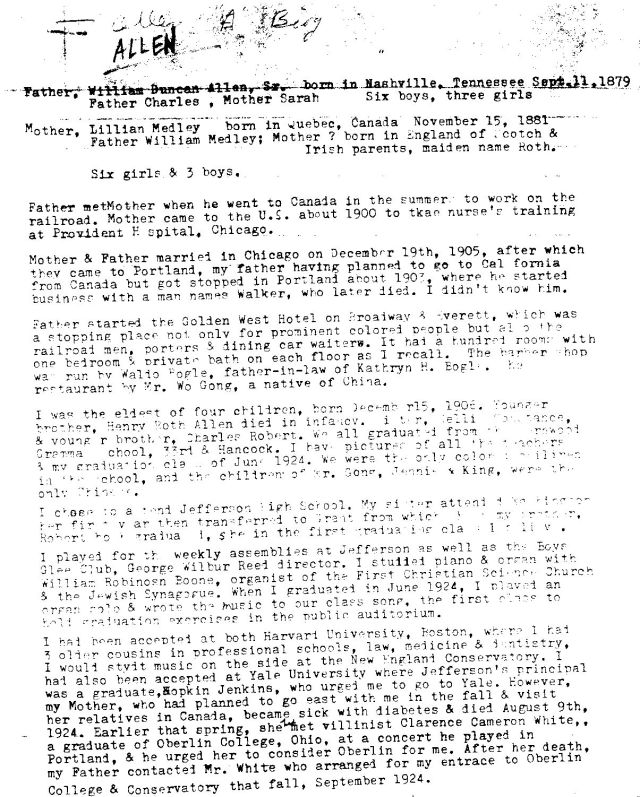
Oral/Writen Interview: W.D. ALLEN JR
But that oral/written history was something he had done for what I believe was the University of Chicago, who was interviewing prominent Black Musicians on their stories. That would be my Uncle "Dunc", who wrote that. We actually have the original letter he wrote of the one you attached, which describs the history of the family. We also have a photograph of WD Sr.’s parents, Charles and Sarah (my Great-great grandparents) and their 9 children (including WD Allen, Sr.).
Yah that’s my Uncle Dunc, we have more things from him than we want! Haha. Aside from being a famed concert pianist, he was an avid fan of the typewriter. I remember receiving many letters when I was younger. But that oral/written history was something he had done for what I believe was the University of Chicago, who was interviewing prominent Black Musicians on their stories.If you want any information regarding WD Jr., we have more than enough, including a playbill which stated: "Starring Paul Robeson and Accompanied by William Duncan Allen Jr." But both Uncle Dunc and his younger sister Constance ("Nellie" as she was called) were classically trained concert pianists, who very much involved with the Black Experience. I have a letter addressed to both WD Jr. and Nellie (as well as her husband Hughe) from Ralph Bunche, where he describes his then recent experience at the March from Selma to Montgomery for voting rights.
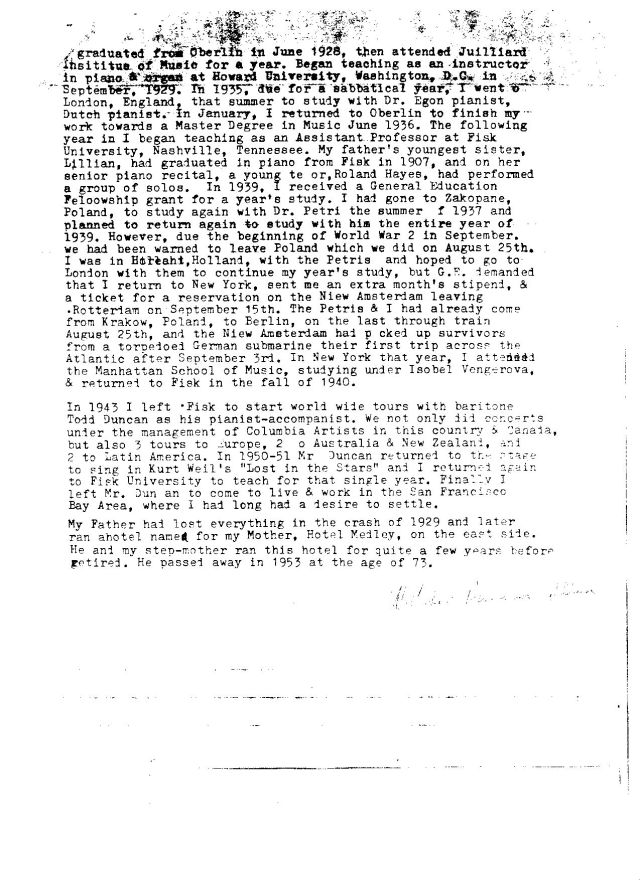
But that oral/written history was something he had done for what I believe was the University of Chicago, who was interviewing prominent Black Musicians on their stories.
That would be my Uncle "Dunc", who wrote that. We actually have the original letter he wrote of the one you attached, which describs the history of the family. We also have a photograph of WD Sr.’s parents, Charles and Sarah (my Great-great grandparents) and their 9 children (including WD Allen, Sr.).
Yah that’s my Uncle Dunc, we have more things from him than we want! Haha. Aside from being a famed concert pianist, he was an avid fan of the typewriter. I remember receiving many letters when I was younger. But that oral/written history was something he had done for what I believe was the University of Chicago, who was interviewing prominent Black Musicians on their stories.If you want any information regarding WD Jr., we have more than enough, including a playbill which stated: "Starring Paul Robeson and Accompanied by William Duncan Allen Jr." But both Uncle Dunc and his younger sister Constance ("Nellie" as she was called) were classically trained concert pianists, who very much involved with the Black Experience. I have a letter addressed to both WD Jr. and Nellie (as well as her husband Hughe) from Ralph Bunche, where he describes his then recent experience at the March from Selma to Montgomery for voting rights.

“This is not your traditional Oregon history kids may have learned in social studies class in fourth grade,” said Marcia Arganbright, district director of curriculum and instruction.
“Beyond the Oregon Trail: Oregon’s Untold History” is one of four books recommended for eighth-graders.
She said the district didn’t seek a curriculum dealing with racism but found that “Beyond the Oregon Trail” met the goals of seeing history in a different way.
Some of the state’s racial history has been glossed over, and likely will provoke strong feelings and discussion.
For example: After slavery was declared illegal by the provisional government of what is now Oregon in 1844, residents passed the “Lash Law” requiring African Americans to be whipped if they refused to leave. Whipping was changed to forced labor six months later, although there is only one record of a person leaving because of it.
The law was changed in 1862 to charge African Americans, Chinese, Hawaiians and multiracial people an annual tax of $5 to live in the state, about $770 in today’s money.
“We had to create a safe space to talk about this so everyone leaves with their dignity intact,” said Shauna Adams, co-author, consultant and trainer on cultural competence.
“We wanted to make sure it wasn’t blaming language, but we have to be willing to look at the ways we can participate in bias, even unknowingly. That’s something young people can understand if we offer it up to them in ways they can hear it.”
The concept was created by Oregon Uniting, a community group that worked to initiate dialogue about race in Oregon. The group received a grant to create a curriculum to help students better understand Oregon’s racial past.
Co-author Keisha Edwards said they had a specific mission in mind.
“A lot of multicultural curriculum has dealt with celebrating differences,” said Edwards, a consultant and curriculum developer for the Northwest Regional Education Laboratory.
Instead, the class will visit where it hurt””the racism, sexism, classism, homophobia.
In 2004, Oregon Uniting merged with another organization to form Uniting to Understand Racism to promote understanding of racism through education and conversation.
Sheila Griffie, executive director of Uniting to Understand Racism, said the new curriculum sprang from the organization’s dialogues on racism with community groups and corporations.
“The school curriculum is a history that gives young people a more full picture of what Oregon is about. … It’s not just Lewis and Clark.”
Over 188 years, federal and Oregon governments passed more than 30 racial discriminatory laws.
Many dozed for years in the statute books, forgotten and unused.
There were three exclusion laws banning blacks from the state that passed before statehood in 1859.
In 1849 it was ruled illegal for blacks to settle in the new Oregon Territory at all, a law that remained until 1854.
Oregon became the first state admitted to the union with an exclusion law in its constitution. It was removed in 1926.
“Whites and half-breed Indians” could claim land under the 1850 Donation Land Act. Blacks could not.
In 1866 the state rejected the 14th Amendment granting citizenship to blacks, and extended the marriage ban to anybody a quarter or more Chinese or Hawaiian or half or more Indian. That was state law until 1951.
In 1883 an attempt to amend the state constitution to remove the ban on black voting failed, and it didn’t pass until 1927. Oregon voters got around to ratifying the 15th Amendment to the U.S. Constitution, which did the same thing, in 1959.
Joyce Harris of the Maryland-based National Association for Multicultural Education said the adoption of material such as “Beyond the Oregon Trail” would help debunk the idea that truth and history come from only one source.
“If we think of truth as being the sum of multiple perspectives, then we get a more accurate picture of history and a more accurate, equitable and just picture of today,” Harris said.
 |
|
Jefferson Centennial and |
Click this LINK to go to a PDF ad for window display…not fancy, just text.
Send an email to mailing list and receive the latest news. Be sure to include your mailing address and phone number if you want to be contacted other than by email. And don’t forget to indicate what year you graduated.
Correspondence and donations: Jefferson Centennial Celebration
P.O. Box 2379 Clackamas, OR 97015
Next planning meeting, contact committee chairpersons:
jdmatheson(at)mac(dot)com Jackie Matheson or amehas(at)msn(dot)com Ann Meha
Nominations for 100 Outstanding Democrats now being accepted.
Help make the centennial celebration even more memorable for your friends and relatives by nominating them to be one of the 100 Outstanding Democrats who will be honored in celebration of the Jefferson High School Centennial Celebration at the banquet on May 29, 2009.
The fifteen categories for nomination are Agriculture, Arts, Business/Industry, Community, Education, Government, Law, Literature, Media, Medicine, Military, Music, Performing Arts, Science and Sports. All Demos are eligible, whether they attended briefly or graduated from Jefferson.
Jefferson 5K Fun Run/Walk-a-thon Pledge Form Ambassador Edward Joseph Perkins ’47 to speak at Friday dinner! Click here for PDF flyer.• James Siscel is completing the Jefferson Stamp which will be for sale at the Saturday Reunion, the price is $3.00.Send photos and stories to be included in the Photo Album to Photos. Be sure to label and date the images.Please include memories of a school event, teacher or fellow student that affected you. Hot new item, Jefferson Throw. Click on the image to go to the throw page:


 Portland's Golden West Hotel Survival Paradox