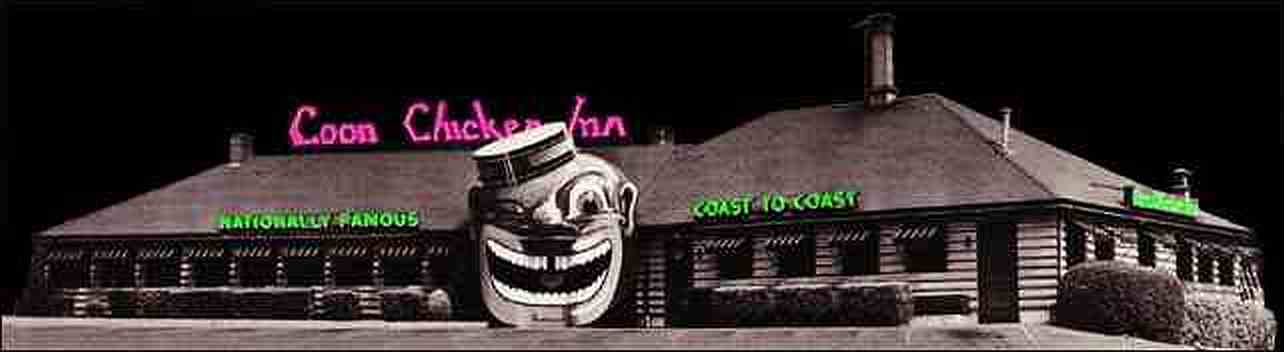
source: BLACKINFORMANT.COM Curator’s Notes: The Coon Chicken Inn was a highly successful restaurant chain from the late 1920s through the 1950s. A grinning, grotesque head of a bald Black man with a porter’s cap and winking eye formed a restaurant’s entryway. The door was through the middle of his mouth. The restaurants sold southern fried Coon Chicken sandwiches, chicken pie, livers — and hamburgers, seafood, chili, cakes, and assorted sandwiches. When possible, Blacks were used as waiters, waitresses, and cooks. The grandson of its founder wrote a brief history of the Coon Chicken Inn chain. We thank him for allowing us to print his account. (from the Jim Crow Museum of Racist Memorabilia)
“The original location of the Black community in Portland was in close proximity to Union Station where much of the Black economic life and employment life was centered.”
– Darrell Millner
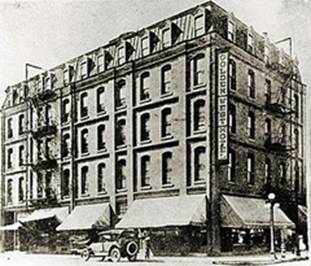
“[My grandfather] saw there was this Black community that mainly worked for the railroad and there was no place for the Blacks to stay….In 1905 he purchased a building and in 1906 opened up the Golden West which was the largest Black-owned hotel west of the Mississippi.”
– Anthony I. Allen
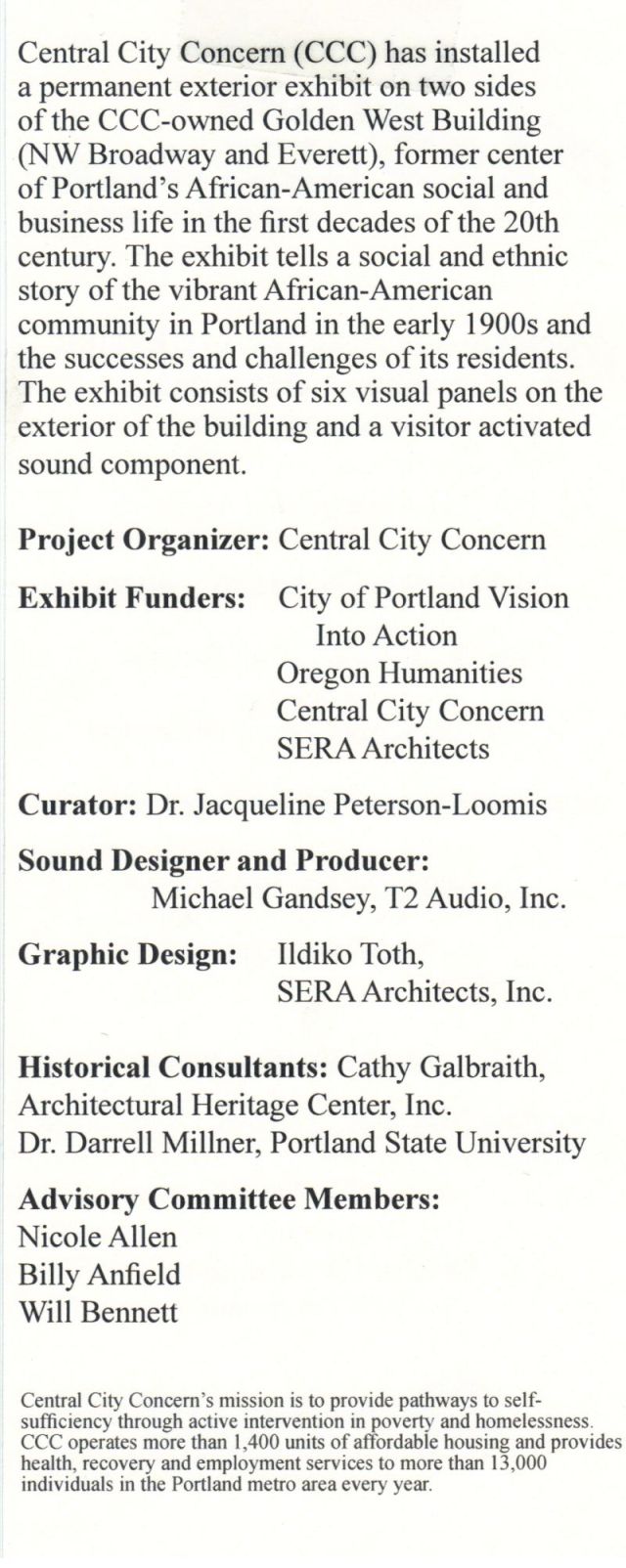
This permanent exterior exhibit, installed in 2009, tells a social and ethnic story of the vibrant African-American community in Portland in the early 1900s and the successes and challenges of its residents. The exhibit – featuring six panels and a soundtrack– can be seen and heard by the public on both sides of the Golden West Building, 707 NW Everett at Broadway.
“ Theater Draws Color Line ”
W.D. Allen and his son Robert, (latter a Senior at Grant High School), attended a performance at the Orpheum Theater on Tuesday evening. On entering the usher told them to go upstairs. Mr. Allen then inquired if there were not seats downstairs. The usher said there were, but that Colored people were prohibited from occupying them. Mr. Allen and his son ignored the usher and took seats downstairs. Later, they were approached by the manager who is quoted as having said: “Gentlemen, I would like to see you out in the lobby.” Mr. Allen: “I don’t care to go out there, and I don’t care to be molested. I came to see the show.””
– Portland Advocate, October 5, 1929
“Had The Biggest Gambling Estabishement On The West”
1906-1931
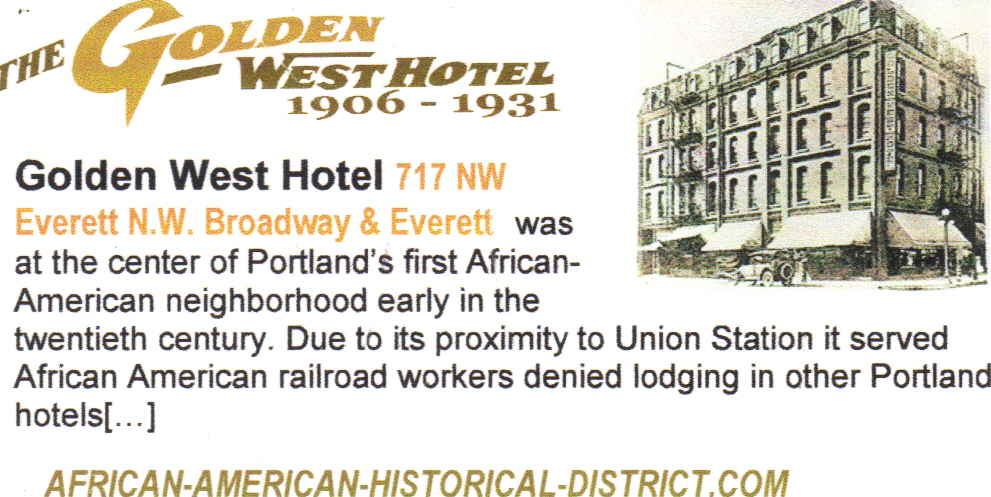
When Black entrepreneur W.D. Allen launched the Golden West Hotel in 1906, Portland was booming. The completion of the transcontinental railroad, the opening of Union Station and the Lewis and Clark Centennial Fair triggered a flood of visitors and workers to the city’s bustling North End. The Golden West was designed to serve the Black railway porters, cooks, barbers and waiters recruited by the major railroads. It provided “all the conveniences of home” for Black workers denied accommodation in Portland’s white owned hotels, and was a center of African American social life until the hotel’s closure in 1931.
Patrons could get a haircut and a shave at Waldo Bogle’s Barbershop, sweets at A.G. Green’s ice cream parlor and candy shop, and relax in George Moore’s Golden West Athletic Club featuring a Turkish bath and gymnasium. In its heyday, the Golden West provided an overnight home for prominent black entertainers, athletes, and civic leaders such as Illinois Congressman Oscar DePriest and labor organizer A. Philip Randolph. Some even “retired” there, including Portland Advocate newspaper founder and famous Portland Hotel “hat check man,” E.D. Cannady.
-Click-Map-Below-
The Golden West Hotel closed in 1931, a victim of the national economic Depression. The “New Golden West Hotel” opened in 1933 but closed in 1935. Other closures plagued the hotel until 1943, when it reopened as the Broadmoor Hotel, surviving until 1984 as low cost housing. Through the efforts of the building’s present owner, Central City Concern, and with the assistance of the Portland Development Commission, the building has been rehabilitated and the name restored to recognize the Golden West Hotel’s significant role in the history of Portland.
Cuarator: Graphic Design: Ildiko Toth, SERA Architects, Inc.
Historical Consultants: Cathy Galbraith, Architectural Heritage Center, Inc.
Dr. Darrell Millner, Distinguished Professor@Portland State University.
Advisory Committee Members: Nicole Allen, Billy Anfield, Will Bennett, Michael “Chappie” Grice,
Bill Hart
LOCAL COLOR IS NOW ONLINE
Will, In the future, please have anyone interested in getting copies of “Local Color” or in having a public showing of Local Color to contact me directly. We have a limited number of copies of the program and want to make sure they are distributed fairly.
Please email me with your request for copies including a description of who will get the copies and how they will be used.
Jeff Douglas Vice President of Local Production JDouglas@opb.org Thank you | OPB-TV
Will, In the future, please have anyone interested in getting copies of “Local Color” or in having a public showing of Local Color to contact me directly. We have a limited number of copies of the program and want to make sure they are distributed fairly.
Please email me with your request for copies including a description of who will get the copies and how they will be used.
Jeff Douglas Vice President of Local Production
JDouglas@opb.org Thank you | OPB-TV
This 1991 OPB documentary chronicles the little known history of racism in Oregon and the moving story of people, both black and white, who worked for civil rights. Jon Tuttle was a news reporter in Portland for most of his life but said he was unaware of much of this history until late in his career. He set out to document the story but found he was almost too late as some of the important participants had died and others were getting on in age. Local Color is the story of black Oregonians and their struggle for equality told by the people, both black and white, who lived the history. But there are moments of highly disturbing racism in a state not known for racial diversity. But there are also moments of inspiration and courage as people take a stand to bring about important change. Without this historic documentary, many of these stories, from some of the state’s best people might have been lost and forgotten.
LOCAL COLOR IS NOW ONLINE
Will,
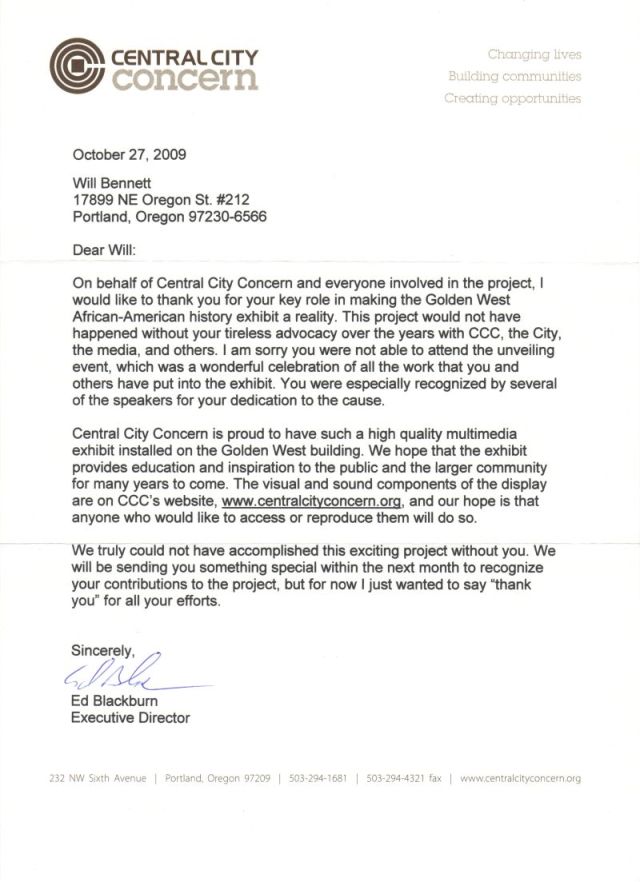
This would not have happened without your perseverance and dedication. The exhibit does a great job telling the story of the Golden West and the broader historical context of the African-American experience in Portland in the early 20th century.
Thanks. N.
¨ Nicholas T. Starin, City Planner
¨ Historic Resources Program & Central Portland Team
¨ Portland Bureau of Planning & Sustainability
¨ 1900 SW 4th Avenue, Ste. 7100
¨ Portland OR 97201-5380
¨ nstarin@ci.portland.or.us
Click here to download the Golden West Hotel Historic Display Panels–Electronic download the Golden West Hotel Historic Display Panels–Electronic Verisons with audio|includes JPG-PDF-MP3-DOCS files
We had to cut the documentary portion of the course due to time constraints, but we are still interviewing and creating an archive. If you know someone who is interested in filming a documentary, we’ve collected a lot of great stories and there are a lot of people who would love to watch it!
The project needs people to tell their stories about living in Portland
Real Oral Interviews | Real PSU Students
Felicia Williams, fwilliam@pdx.edu
The Civil Rights movement changed the way people thought about race and equal opportunity in America. This course will examine how the movement happened in Portland as students record oral histories from African Americans who fought for Civil Rights in Oregon. The interviews will then be digitized and uploaded to the Internet and students will use photographs and clips from the interviews to create a video documentary that can be used publicly.
As an active concerned group of community partners I want to make sure you all saw the Oregonian article about part of the new middle level social studies materials to be used in Portland Public Schools. We will not begin using it until fall 2009.
Portland Public Schools district is the first in the state to use a textbook exploring Oregon’s racial history
by Will Bennett on Friday, November 18, 2011 at 12:58pm ·
Read about how all this came about…
[He’s taken some first steps — connecting with local black studies professors and historians and reaching out to Portland Public Schools. Slowly, the interest is building. He recently presented “Local Color,” a documentary that chronicles Portland’s history of racism, to a group of Portland social studies teachers at Franklin High School’s Professional Development Day, in an effort to help bring more local African American history into the curriculum.]
[…It all began when he made a call to Portland Public Schools to demand a change in curriculum when it came to teaching the truth about the way African Americans had been treated. They gave him a speaking slot. He was terrified about what he was going to say…]
To read the rest of the story click link below:
“Amateur Historian Pushes Behind the Scenes History”
[Portland Public Schools is poised to adopt a new curriculum today, making the district the first in the state to use a textbook exploring Oregon’s racial history.]
House Passes Bill to Rename Portland Post Office after Martin Luther King, Jr. Bill to Go to President Obama for Final Signature
Washington, DC – In an effort led by Earl Blumenauer (D-Ore), the House today passed a bill that would designate the U.S. Postal Service located at 630 Northeast Killingsworth Ave. in Northeast Portland as the “Dr. Martin Luther King, Jr. Post Office.” The bill was supported by every member of the Oregon delegation in both the House and the Senate.
The bill is the result of a community effort led by local letter carriers Jamie Partridge and Isham Harris. In 2007, Mr. Partridge and Mr. Harris collected employee signatures supporting the renaming, as well as letters of support from the Piedmont and Concordia Neighborhood Associations, and the Sabin Community Association.
Following is a statement from Congressman Blumenauer:
“I am proud to send this bill to President Obama on behalf of Isham Harris and Jamie Partridge, two dedicated Portland carriers who spearheaded this effort. Naming the post office after Dr. Martin Luther King Jr. will serve as a daily reminder of his work and the work that continues to make America a more just nation. For me, it is an honor to finish the grassroots effort that began two years ago and send this legislation to the President.”
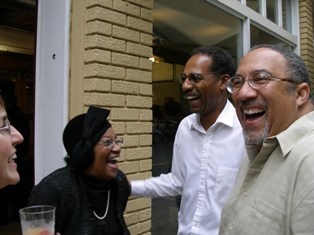
The woman’s name in black is Willie Richardson, from Salem. The woman on the left, is Jodi Cheever from Portland. -by Photo by Brian Stimson
Anthony I. Allen never knew W.D. Allen, his grandfather and the original owner of the Golden West Hotel, but he knows all the stories. From the time he was a child growing up in Los Angeles, Anthony Allen learned all about Portland’s historic Black hotel — located at 7th and Broadway Downtown — one of the only formal lodging houses in town that catered to African Americans in the first few decades of the 20th century.
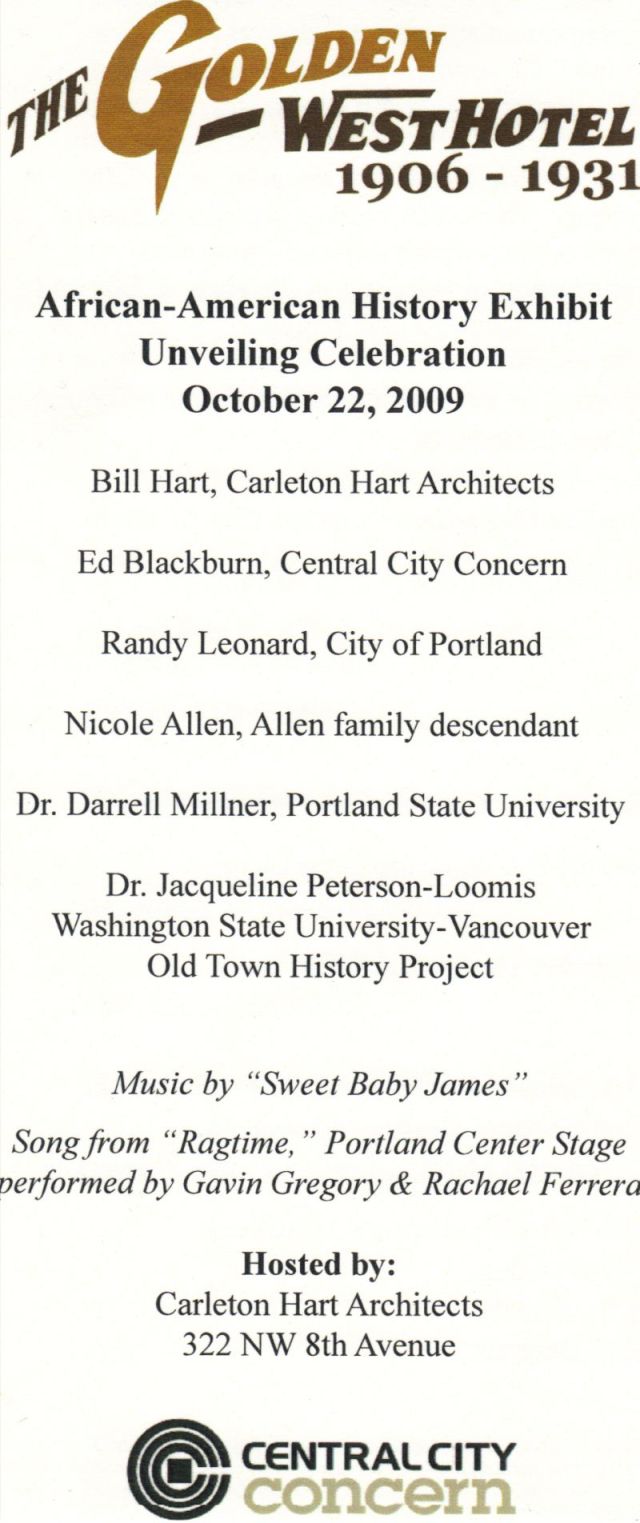
On Oct. 22, Allen and many others – including PSU Black Studies Professor Dr. Darrell Millner, W.D. Allen’s great-granddaughter Nicole Allen nallen@pdx.edu, City Commissioner Randy Leonard — gathered at Carlton Hart Architects to celebrate the unveiling of the new Golden West Historical Display. Visible from the street, the display features photos, historical descriptions and even an audio guide to what was once the center of African American culture in Portland.
Pictured above is Anthony I. Allen (right), Bill Hart of Carlton Hart Architects (center), who helped design the panels, and a supporter at Thursday’s event on 10.22.09.
>> Greetings Everyone: I am using this earlier email to get all of your email addresses. GREAT event on Thursday & many thanks to EV evarmitage@centralcityconcern.org for wonderful coordination & all of you great speakers. It was a grand success with so much positive energy in Bill’s office (major thanks to Bill & Carleton-Hart for hosting.
Will, This would not have happened without your perseverance and dedication. The exhibit does a great job telling the story of the Golden West and the broader historical context of the African-American experience in Portland in the early 20th century. Thanks.
N.
¨ Nicholas T. Starin, City Planner
¨ Historic Resources Program & Central Portland Team
¨ Portland Bureau of Planning & Sustainability
¨ 1900 SW 4th Avenue, Ste. 7100
¨ Portland OR 97201-5380
Will – I’m so sorry you’re not feeling well, we missed you at the Golden West exhibit celebration last night. It was a great event with over 160 people there and wonderful energy. The speeches and music went well and people were mingling, looking at the exhibit, and having a good time. You were specifically thanked by Ed Blackburn and Jackie Peterson for all your work making the project happen. And now the exhibit is up on the building for a long time to come, for anyone to see and hear. Thanks for your major role in moving this all forward and making it happen. – EV
E.V. Armitage
Executive Coordinator
Central City Concern
232 NW Sixth Avenue
Portland, OR 97209
Direct 503-200-3885
Main 503-294-1681
Fax 503-294-4321 www.centralcityconcern.org
To sign up for the CCC e-newsletter, click here .
P Please consider the environment before printing this e-mail
The information contained in this message may be legally privileged and confidential
>> GOLDEN WEST PROJECT
>> https://goldenwest.wordpress.com
>> BUILDING A NETWORK FOR PRESERVATION OF
>> PORTLAND’S & OREGON’S AFRICAN AMERICAN
>> EXPERIENCE/HISTORY…AND MORE!!!
Yes, I’m sorry to have missed you too. I understood that you weren’t feeling well and so didn’t attend – but I’m sure you’ve heard from others that it was an exciting and well-attended event. I hope you’re feeling much better by now.
Meeky
Meeky Blizzard
Advisor for Livable Communities
Congressman Earl Blumenauer
fwilliam@pdx.edu wrote: Hi Will, There was a photographer from the Oregonian there and I know that Michael Chappie Grice also took a lot of pictures. It was a fantastic evening and the only thing missing was you. Congratulations!
Will, It was a very moving and impactful experience for me and my wife to learn more about Blacks in Portland. We are close friends with Dick and Nola Bogle. Thanks for the picture and please keep me on your mailing list for any future events. Best Wishes, George
fwilliam@pdx.edu wrote:
> Hi Will,
>
> There was a photographer from the Oregonian there and I know that Michael Chappie Grice also took a lot of pictures. It was a fantastic evening and the only thing missing was you. Congratulations!
>
> Felicia Williams
>
>
> Quoting INFO :
>
>> All =
>> I only could i find words…
>> Anymore pic to share?…
>> see link
>> “Unveiling” Golden West Historic Event:
>> http://tinyurl.com/ylln3n8
>> peace
>> will b.
>> ——– Original Message ——–
>> Subject: RE: Golden West History Exhibit Unveiling: October 22nd! THANKS
>> Date: Mon, 26 Oct 2009 11:57:54 -0700
>> From: Cathy Galbraith
>> To: ‘EV Armitage’ , ‘WILL BENNETT’ , , ‘michael gandsey’ , , , ‘Billy Anfield’ , ‘Jackie ‘ , ‘bill hart’ ,
>> References:
>>
>> Greetings Everyone:
>>
>> I am using this earlier email to get all of your email addresses.
>> GREAT event on Thursday & many thanks to EV for wonderful coordination & all
>> of you great speakers. It was a grand success with so much positive energy
>> in Bill’s office (major thanks to Bill & Carleton-Hart for hosting.)
>>
>> Will – we missed you terribly and you got the recognition that you deserve!
>> I hope you are feeling better.
>>
>> EV – please extend thanks to Robert from all of us, and the rest of the CC
>> team.
>>
>> It was an unforgettable evening all around and first rate, from start to
>> finish.
>> Thanks again – Cathy Galbraith,
>> Bosco-Milligan Foundation
>>
>> GOLDEN WEST PROJECT
>> https://goldenwest.wordpress.com
>> BUILDING A NETWORK FOR PRESERVATION OF
>> PORTLAND’S & OREGON’S AFRICAN AMERICAN
>> EXPERIENCE/HISTORY…AND MORE!!!
To speak of Mahalia Jackson’s voice is to speak of magic and mystery and majesty. Hers is not a voice. It is a force of nature. It moves with the power of a tornado and soothes with the tenderness of a spring rain.
In describing the legendary gospel singer, Dr. Martin Luther King Jr. once said: “A voice like hers comes along once in a millennium.”
He could just as well have been talking about her life’s journey and the influence she had not only on gospel music, but on American music itself — from blues to rock and roll — and its impact on the world.
The woman who would one day be called the greatest gospel singer in the world was born in New Orleans on October 26, 1911. Her childhood home was a three-room house in the Black Pearl section of the city. It was a tiny space, home not only to little “Halie,” and her mother and brother, but to assorted aunts and cousins, too. In total, thirteen people and a dog shared that home.
Mahalia’s mother died when she was five, adding more hardship to her young life. She was raised by her Aunt “Duke,” who allowed no secular records in the home and who treated Mahalia and her cousins harshly when they failed to keep the family home immaculate.
Mahalia began singing in church as a child. Quickly it became apparent that she had a tremendous talent and possessed a voice that was rich, strong and impressive. One family member said Mahalia would one day sing before royalty. Eventually, that came true.
After moving to Chicago in 1927 as a teenager during the Great Migration north, word of her amazing voice began to spread — first in local churches, and soon in churches across America. In 1948, she recorded “Move On Up a Little Higher” for Apollo records.
It was a spectacular success — groundbreaking, in fact, because no gospel song had ever achieved such sales on the secular side of the music industry. Stores across the nation scrambled to keep up with the demand for Mahalia Jackson’s first and greatest hit.
The song propelled Jackson to worldwide celebrity; she became a force in radio and television, areas off-limits to African American musicians and entertainers. In 1954 she began hosting a popular Sunday night radio show for CBS. Her appearance in 1956 on the Ed Sullivan Show lifted gospel music from churches and revivals into mainstream American music, where it remains to this day.
She performed in the White House for President Eisenhower, sang at the inauguration of John F. Kennedy, and travelled with Dr. King throughout the South, singing powerful gospel hymns before many of his speeches, including, at his request, a spiritual just before his “I Have a Dream” speech in Washington, D.C., in 1963.
Just as her family had predicted, she performed before royalty, singing at London’s Royal Albert Hall when her first European concert tour brought her to England in the mid-1950s. During that tour she would also sing in France, Germany and Denmark.
Later international tours found Jackson performing before the royal family in Japan and meeting numerous heads of state such as Indira Gandhi, prime minister of India.
Countless singers and other musicians recognized her talent. In 1958, she collaborated with famed African American composer and band leader, Duke Ellington, on the album Black, Brown and Beige. Many music scholars believe this was Ellington’s finest and most ambitious work, and certainly the one in which he made his deepest emotional investment. Mahalia Jackson’s contribution was substantial. It was on this recording that she gave one of music history’s most stirring performances — a heart-stopping rendition of “Come Sunday.” Ellington wrote it specifically for her and she made it her own thanks to her deep-velvet voice and her soul-stirring spirituality.
Jackson was frequently offered lucrative deals to sing in more popular secular styles, declining those offers, for the most part, to stay faithful to her gospel roots. Mahalia Jackson passed away in 1972, just a few months after her 60th birthday. Both Chicago and New Orleans honored her, with tens of thousands silently filing past her casket in tribute. It is estimated as many as 6,000 people attended her funeral service in Chicago; among them were Sammy Davis Jr. and Ella Fitzgerald. At service’s end, Aretha Franklin sang “Precious Lord, Take My Hand,” which had become one of Mahalia Jackson’s signature songs.
Gospel music historian Horace C. Boyer wrote that through her voice and personality Jackson enlightened people worldwide to “respect gospel music as an idiom distinct from classical black spirituals.” True to the idea that the African American story is an American story, it is hard to imagine contemporary music without the influence of Mahalia Jackson. This point is underscored by her induction into the Rock and Roll Music Hall of Fame in Cleveland, Ohio in 1997.
This is just one Page from Our American Story. However, it serves to underscore the mission of the Museum: to open a door to conversation and understanding not only to the African American experience, but also to how that experience has played an integral role in shaping our nation from its very beginnings.
The greatest revolution of our generation is the discovery that human beings, by changing the inner attitudes of their minds, can change the outer aspects of their lives. -- William James
 source: BLACKINFORMANT.COM Curator’s Notes: The Coon Chicken Inn was a highly successful restaurant chain from the late 1920s through the 1950s. A grinning, grotesque head of a bald Black man with a porter’s cap and winking eye formed a restaurant’s entryway. The door was through the middle of his mouth. The restaurants sold southern fried Coon Chicken sandwiches, chicken pie, livers — and hamburgers, seafood, chili, cakes, and assorted sandwiches. When possible, Blacks were used as waiters, waitresses, and cooks. The grandson of its founder wrote a brief history of the Coon Chicken Inn chain. We thank him for allowing us to print his account. (from the Jim Crow Museum of Racist Memorabilia)









 Portland's Golden West Hotel Survival Paradox